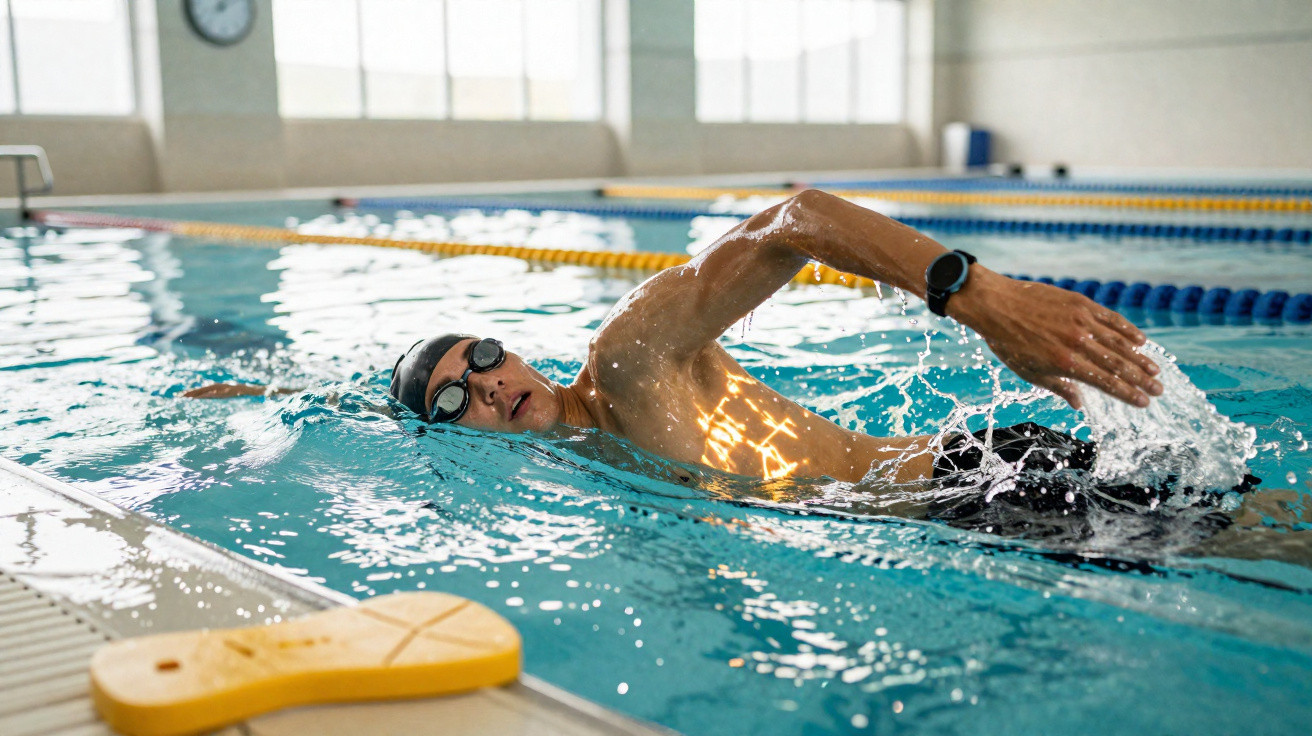
Swimming has long been regarded as an insider tip for tackling belly fat and love handles: it is kind to the joints, refreshing, and rarely leaves you feeling completely wiped out afterwards. Yet one question keeps returning: how long do you actually need to stay in the pool before there is a measurable change around your waist – not merely in your mind, but at the waistband of your trousers?
Why swimming works so well for belly fat
Swimming brings together two factors that matter for a flatter stomach: endurance exercise and muscular effort. It gets the heart and circulation working, makes the body use energy, and engages the shoulders, back, legs and, above all, the core.
Unlike jogging or jumping, the water supports your body weight. There is no harsh impact on the spine and the joints are protected. This means that people with back or knee problems in particular can often train more intensely than they could on land.
“Every stroke in the water forces the torso to remain stable – and that means the abdominal muscles are working continuously.”
Water resistance offers another advantage: with every movement, the muscles work against gentle resistance. Over time, this helps to tone the core and firm up the stomach, even if the number on the scales is only falling gradually.
Why you cannot lose weight only from your stomach
It is not possible to lose fat exclusively from your stomach. Your body determines which fat stores it draws energy from – sometimes more from the legs, sometimes from the hips or abdomen. However, anyone who burns calories regularly while strengthening their abdominal muscles will change their overall shape. The stomach can look flatter and the upper body more defined, even where overall weight loss is “only” modest.
Swimming also stimulates the metabolism. After a more demanding session, calorie expenditure remains elevated for a while, even once you are back on the sofa. This so-called afterburn effect enhances the impact of training over the long term.
The ideal duration: how long a swimming session should last
An experienced swimming coach associated with a major sports retailer puts it plainly: if you want to focus on your stomach, swimming should not be treated as a brief splash about.
“The coach’s recommendation: swim for at least 45 minutes per session – at a pace you can clearly feel, but can still comfortably sustain.”
The reasoning is straightforward: it takes several minutes in the pool for the circulation to get fully going, the heart rate to rise and the muscles to warm up. Maintaining a moderate, steady pace afterwards allows the body to keep using energy without immediately reaching its limit.
How intense should your effort be?
A useful rule of thumb is that you should be somewhat out of breath but still able to speak in full sentences. If you are gasping for air after every length, you are swimming too hard and are unlikely to manage the full 45 minutes. If chatting feels effortless, you can increase the pace slightly.
The coach recommends staying within the light-to-moderate endurance-training range. At this intensity, the body makes greater use of fat stores rather than relying solely on rapidly available carbohydrates.
How many calories do different swimming strokes burn?
The exact calorie figure always depends on body weight, technique and pace. The coach gives the following guide values for half an hour at moderate to athletic intensity:
- Breaststroke: around 340 calories per 30 minutes
- Butterfly: around 380 calories per 30 minutes
If you swim front crawl or backstroke with sound technique, you will usually be in a similar range to breaststroke, and potentially slightly above it if your pace is faster.
A sample workout: 45 minutes for a firmer core
To stop a trip to the pool becoming unstructured splashing around, it helps to have a clear routine. The coach suggests a session of around 45 minutes, divided into three sections.
1. Warm-up: settling into the water (10 minutes)
Start gently so that your breathing and pulse can adapt to the effort. Suitable options include:
- 5 minutes of easy breaststroke
- 5 minutes on your back, such as relaxed backstroke or back swimming without pressure
The important thing is not to start too hard. If you give everything during the warm-up, you will fade later on.
2. Main set: cardio and abdominal focus (25 minutes)
The central part of the session is about increasing the pace without becoming completely breathless. It could look like this:
- 4–6 lengths of front crawl or backstroke at a brisk pace
- 2 lengths of easy swimming or kicking with a float to recover your breath
Repeat this alternation between effort and recovery several times. It keeps your heart rate raised and builds up plenty of active minutes without requiring a constant all-out sprint.
If you are sufficiently confident in the water, you can also add short sprints: swim one length as fast as possible, followed immediately by one very slow length. This challenges both the cardiovascular system and core stability.
3. Abdominal circuit in the water: targeted exercises (10 minutes)
Finish with a compact “abdominal block” to work the deep muscles directly once more. The coach recommends incorporating three straightforward exercises:
- Kicking with a float: three rounds of 2 minutes of powerful kicking, with 30 seconds’ rest between each round
- Front crawl with pronounced torso rotation: four slow lengths, consciously rotating the hips and upper body – this particularly works the oblique abdominal muscles
- Knees to chest at the pool edge: hold on to the pool edge with your legs in the water, then draw your knees towards your chest – three sets of 15 repetitions
“The difference comes from combining endurance work with short abdominal intervals – not from any single miracle exercise.”
How many times a week will really make a difference?
If a visibly flatter stomach is your goal, swimming only occasionally will not be enough. Two sessions a week are a good starting point. Three sessions produce noticeably faster progress, provided your body copes well with the workload.
| Frequency | Expected effect |
|---|---|
| 1 x per week | Slightly improved body awareness, barely any visible change |
| 2 x per week | Noticeably greater endurance, first visual effects after several weeks |
| 3 x per week | Clearer toning, a noticeably flatter stomach with an adjusted diet |
Consistency is what matters most. Anyone who trains reliably for four weeks will establish a routine, notice improvements in their breathing and be able to raise the pace gradually.
Diet, everyday habits and common mistakes
Even the best pool session cannot offset a permanently high-calorie diet. The coach stresses that swimming should go hand in hand with adjustments to your eating habits: fewer highly processed foods, more vegetables and protein, and a moderate approach to sugar and alcohol.
A common pitfall is overindulging because of post-workout hunger. If you eat a huge portion of fast food immediately after swimming, you undo a large part of the session’s benefit. A protein-rich snack is a better option: quark, yoghurt with berries, an omelette, or wholemeal bread with a lean topping.
Who benefits most from swimming?
Swimming is particularly beneficial for people who are overweight or have joint issues or back pain. They can train intensely without overloading their joints. Beginners who feel unsure about jogging can also find a safe environment in the water.
More experienced exercisers often use swimming to complement strength training or running. It keeps the body active without repeatedly exposing it to the same stresses. That lowers the risk of overuse complaints.
Other activities that can further tone your stomach
To boost the effect, you can add short land-based sessions on days when you are not swimming. Useful additions include:
- Planks in different variations, including front planks and side planks
- Gentle Pilates exercises for the core
- Light bodyweight strength training two to three times per week
These sessions do not need to be lengthy. Just 10 to 15 minutes of targeted core exercises on two days each week can help the abdominal muscles respond more quickly to swimming training.
If you follow the 45-minute guideline, go to the pool regularly and do not “reward” every session with an XXL snack, you have a good chance of finding noticeably more room in the waistband of your favourite trousers over the coming months – while also leaving the water fitter, more mobile and more relaxed.














Comments
No comments yet. Be the first to comment!
Leave a Comment