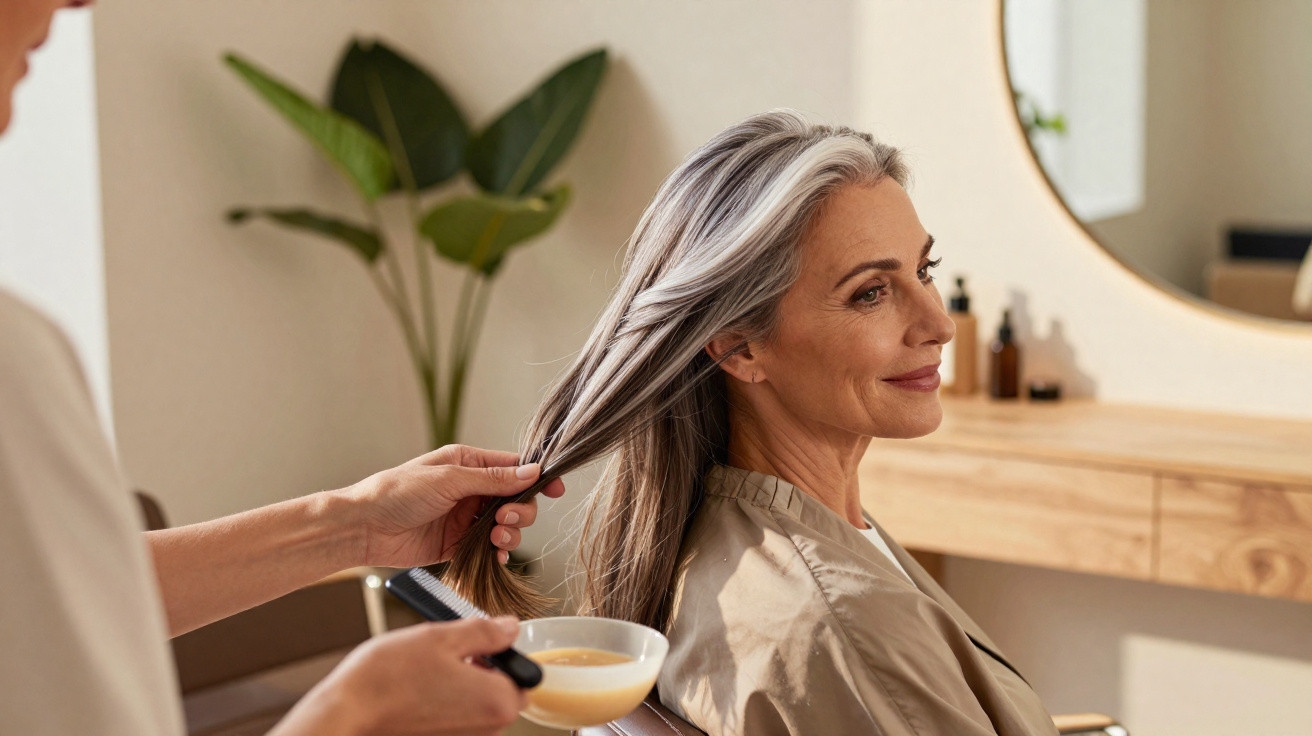
The first detail that stands out is the quiet.
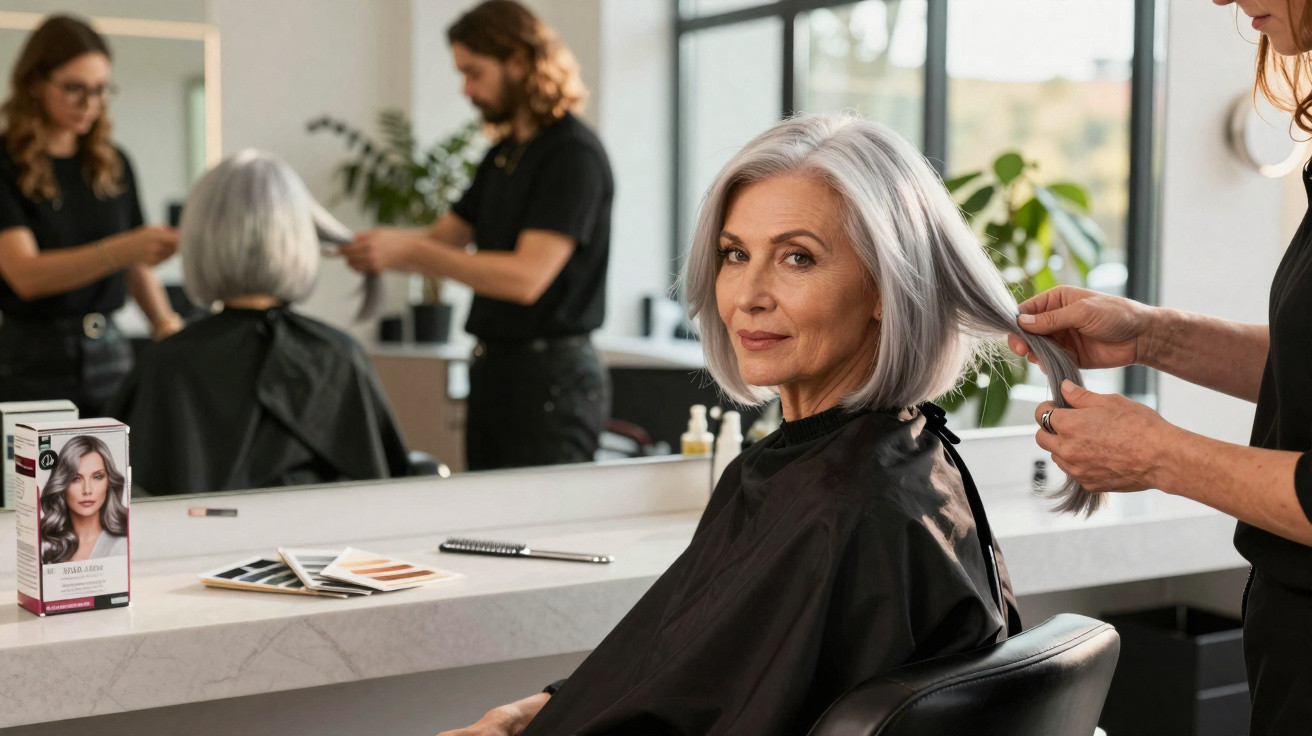
There is no noisy foil crackling or harsh ammonia scent. Instead, a woman in her late forties sits with her hair falling loosely over her shoulders, studying her reflection while a colourist brushes soft, smoky shades through her silver hair. She is not concealing the grey; she is… defining it.
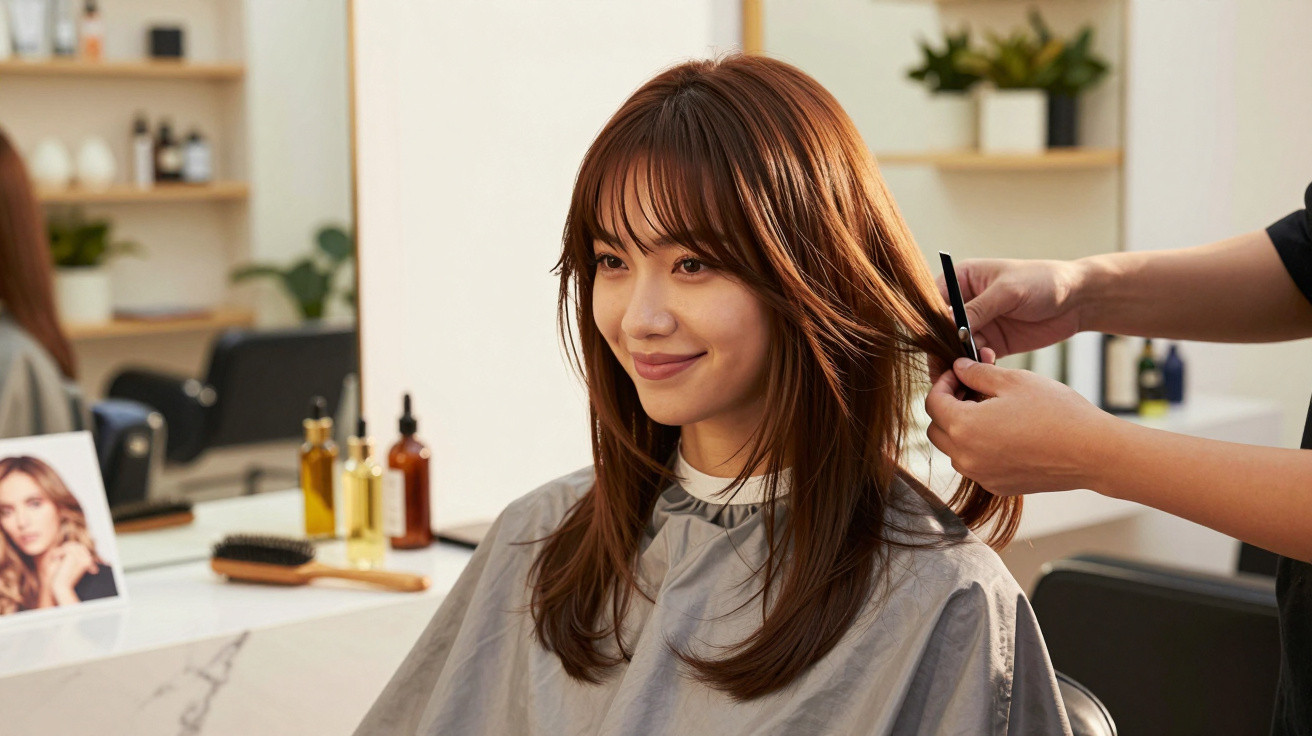
In the chair beside her, a younger client flicks through her phone and holds up a screenshot. “This is the look. I want my grey to blend like this, not disappear.” The colourist agrees, preparing colour that resembles watercolour more than conventional dye: light, translucent hues rather than heavy, uniform pigment.
The salon has the atmosphere of a creative studio, not a battleground against ageing, where hair and time are finding a way to coexist. And it is not only the colour chart that is changing.
A quiet revolution at the mirror
Step into a fashionable salon today and the language used at the colour bar sounds noticeably different. It is no longer “cover the grey”, but “blend it”. Instead of a “root touch-up”, clients hear phrases such as “soft halo”, “smoky shimmer” and “diffused highlights”. Colourists now discuss transition, depth and transparency rather than disguising, masking or erasing.
Rather than battling grey hair, this approach incorporates it. Extremely fine highlights and lowlights are threaded around the natural silver so the shades flow into one another. The finished hair feels modern, relaxed and unexpectedly liberating. The grey remains visible, but it looks deliberate: less “my roots are showing” and more “this is my colour now”.
A London colourist told me that, five years ago, nearly every client aged over 40 scheduled full root coverage every six weeks. She now estimates that close to 60% specifically request grey blending or “soft grow-out” options. In New York, a well-known colour studio created a separate “grey blending menu” after clients repeatedly arrived with Instagram and TikTok screenshots, asking, “Can we do this… without starting from scratch?”
Take Emma, 52, who spent a year moving away from dark brown box dye towards a blended salt-and-pepper tone. She recalls a colleague saying, “You look different… younger, actually.” She laughed, because she had not coloured her roots for months. The change was not about having less grey; it meant less contrast, less anxiety and less pretending.
Conventional permanent dye acts like a curtain, laying down one solid, opaque shade that obscures everything underneath. It can appear crisp for two weeks, but once the hair grows, that curtain rises to reveal a bright white line at the roots. It is this severe divide that can make people feel as though they have “aged overnight” when regrowth becomes visible.
Grey blending is closer to applying a filter. Translucent glazes, micro-fine highlights and deeper lowlights interrupt the grey without removing it. As a result, regrowth looks gentler because the eye is not forced to leap from dark hair to white over a single millimetre. It makes space for the in-between. Psychologically, that is a major change: instead of pursuing an ever-moving target every few weeks, you choose a colour designed to evolve.
How grey blending techniques work
This newer approach is built around a combination of very fine highlights and sheer tones. Colourists commonly begin by assessing where grey is most concentrated - at the temples, along the parting and around the face - before placing “micro-babylights” to repeat that brightness through the rest of the hair. Imagine natural human hair, only with more flattering lighting.
Next come lowlights: strands that are a little deeper, whether cooler or warmer, placed beside the grey to create structure. A transparent gloss or toner is then worked through the hair to reduce brassiness and add a “smoky” or “pearl” effect, rather than a flat brown or blonde finish. Movement, rather than flawlessness, is the aim.
For anyone coming from years of box dye or salon root coverage, the transition may need to happen gradually. A colourist may initially soften the base by one or two shades, then introduce lighter ribbons in strategic areas to allow grey hair to grow through without creating a hard line. This was the route taken by Marc, 45, whose dyed-black hair contrasted strongly with his white temples. Rather than stripping all of the colour, his colourist carefully lifted the base to a dark chocolate shade, added ash highlights around the temples and finished with a cool gloss. By the third appointment, his natural silver had become part of the overall picture instead of calling attention to itself from the edges.
On social media, “grey blending” before-and-after posts can make the same person appear almost unrecognisable - the face is unchanged, but the narrative is different. The after images do not look younger in the traditional sense. They appear lighter, with less strain. As the boundary between “coloured” and “natural” becomes less definite, people often seem to physically relax as well.
From a technical perspective, the principle is straightforward: grey hair reflects light differently because it contains less pigment. Surrounding it with shades that are overly dark or warm makes that contrast highly visible. Choosing neutral or cooler tones, while layering several levels of depth, softens the transition. It is much like blending foundation down the neck for a more even look, rather than ending it sharply at the jawline.
The formulas themselves have improved too. Many current glosses and toners are low-odour, ammonia-free and semi-permanent. Rather than growing out as a stark band, they fade softly. Maintenance therefore moves from a “panic root emergency” to simply “refresh the glow every few months.” Grey blending is not one individual product; it is a new way of approaching pigment, time and the interval between salon appointments.
Trying grey blending: what to request and avoid
If this new direction appeals to you, begin with a discussion rather than a product. Bring images of hair colours with visible grey and genuine texture, rather than heavily filtered selfies with flat-looking colour. Be honest with your colourist about how frequently you are prepared to return and how much change you are comfortable making. That matters far more than your age.
Request “soft grey blending” or a “low-contrast grow-out” specifically, instead of complete coverage. Explain that you want the grey to form part of the overall design. Many professionals will recommend beginning around the face and parting, where attention naturally falls, before widening the approach over time. A strand test can show how your existing colour is likely to respond, helping to prevent the process becoming corrective work.
A frequent mistake is attempting to go directly from years of dark permanent dye to fully revealed grey in a single appointment. That often requires intensive bleaching, causes banding and can test both the condition of your hair and your patience. A gradual blend, in which the previous colour slowly gives way to something softer, is generally the kinder option.
Another common disappointment comes from choosing shades that are too warm when the natural grey is cool and silvery. Golden highlights beside cool grey can quickly turn orange. A skilled colourist will usually guide you towards ash or neutral tones that complement your natural sparkle rather than compete with it. And yes, a purple or blue shampoo will probably be needed at some point… but use it gently. Let’s be honest: nobody really does that every day.
Beneath the practical technique is an emotional element. During a busy Thursday in Paris, one colourist confided:
“People don’t come in asking me to hide their age anymore. They ask me to help them recognize themselves again when they look in the mirror.”
That sense of recognition is what this new wave of colouring truly offers. It is not artificial youth, but continuity with yourself. On a personal level, grey blending feels less like trying to stop time and more like changing the room’s lighting so you can see yourself properly.
For a straightforward guide, these are the points many people find useful when considering the change:
- Bring real, unfiltered images of visible grey hair that you genuinely like.
- Be clear about your budget and how often you can visit the salon.
- Make subtle changes first rather than committing to a complete transformation.
- Coordinate tones with your natural grey: cooler shades for silvery hair and gentler warmth for creamy white.
- Allow a few months for the adjustment. Your eyes need time to appreciate the new version of you.
The wider change: from concealing age to refining it
At a deeper level, this trend reflects how people want to grow older. The first grey hairs were once treated as an emergency. Now, more people appear exhausted by the familiar pattern: cover, reveal, panic, repeat. Grey blending does not erase evidence of time; it rearranges it until it feels less like a judgement and more like an intentional design decision.
You may notice it on a packed train without having a name for it: a woman whose hair shifts from gentle charcoal at the nape to hazy silver around her face, or a man with salt-and-pepper curls that look purposeful rather than uncared for. Collectively, we are learning to appreciate that changing spectrum, rather than beauty at one permanently fixed moment.
| Key point | Detail | Why it matters to the reader |
|---|---|---|
| Grey blending vs. full coverage | It uses highlights, lowlights and toners to merge grey into your natural colour instead of concealing it entirely. | It provides a softer, less stressful option than constant root touch-ups. |
| Maintenance rhythm | Salon appointments can often be extended to 8–12 weeks, with gloss refreshes instead of strict root corrections. | It cuts down on the time, cost and emotional pressure associated with “visible roots”. |
| Personalisation | The method is tailored to your natural grey pattern, tone and lifestyle, rather than your age alone. | It can help you achieve colour that feels personal, rather than a generic anti-ageing mask. |










Comments
No comments yet. Be the first to comment!
Leave a Comment