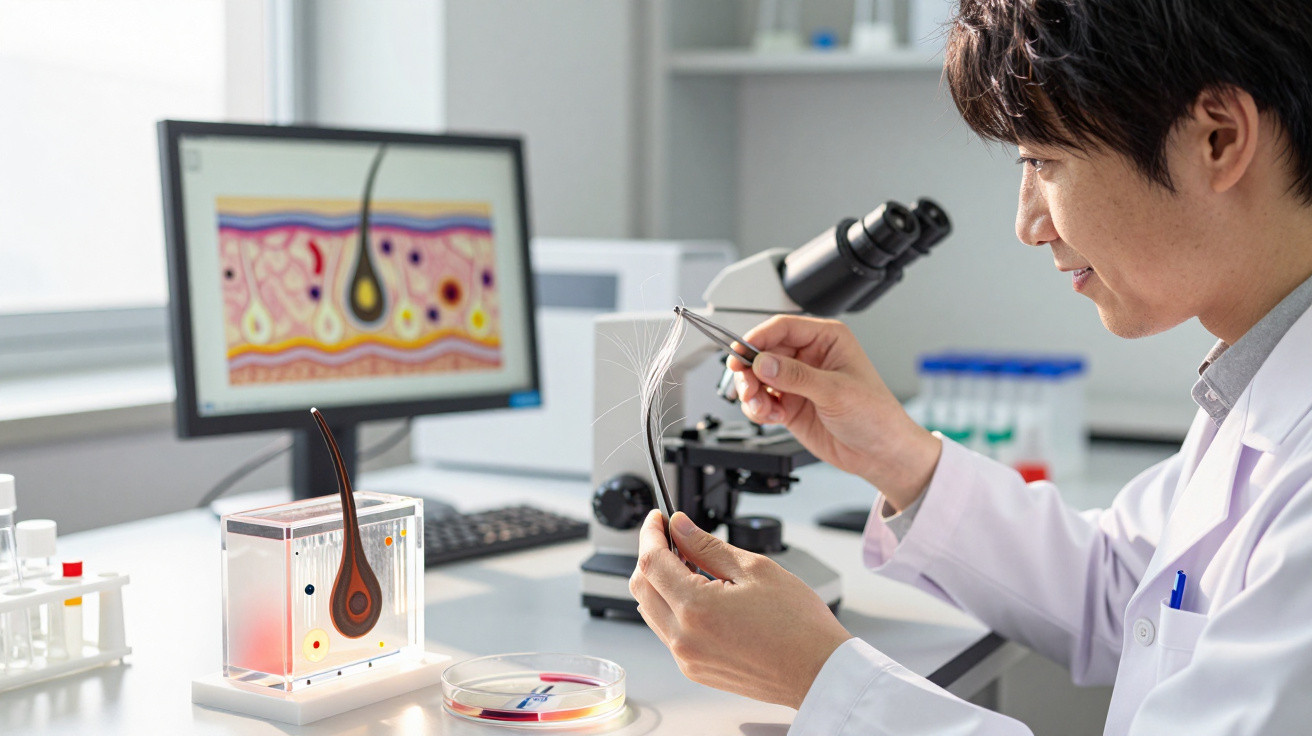
In a Tokyo laboratory, scientists have been watching something unusual: when certain hair cells are damaged, they do not try to repair themselves.
They disappear.
Far from being a minor biological detail, this cellular “giving up” may lie behind a familiar sight in the mirror: hair turning grey or white over time.
Grey hair as a sign of internal defence
Research from the University of Tokyo’s Institute of Medical Science, published in Nature Cell Biology in 2025, offers a striking interpretation: in many cases, greying hair could be a visible sign of a protective system against skin cancer.
The study centres on pigment stem cells, known as McSCs, which live in the hair follicle and generate melanocytes, the cells responsible for hair colour. When the DNA in these cells sustains substantial damage, they may take an irreversible route rather than continue dividing and risk becoming a tumour.
Scientists suggest that, by losing pigment and turning grey, hair may reveal a silent process of cellular “self-sacrifice” against cancer.
This process has been termed “senodifferentiation”: the damaged cell is driven into terminal differentiation and subsequently disappears. The cost is the loss of colour. The likely benefit is a lower risk of melanoma, one of the most aggressive forms of skin cancer.
How this protective mechanism works
The role of pigment stem cells
Within the hair follicle, McSCs occupy a tightly regulated environment called the “niche”. There, guided by chemical signals, they can remain dormant, multiply or become pigment-producing cells.
When their DNA suffers serious harm, such as double-strand breaks, a pathway well known in oncology comes into play: the p53–p21 axis. Across several body tissues, this system is already recognised as a type of emergency brake against tumours.
In hair, researchers found in mice that, under stress such as X-ray exposure, damaged McSCs stop renewing themselves and are pushed into senodifferentiation. Over hair-growth cycles, the effect becomes visible to the naked eye as grey or white hairs emerge.
When the p53–p21 pathway is activated, the cell agrees to “die as pigment” rather than “live as potential cancer”.
The experiments used real-time cell-tracking methods and gene-expression analysis, making it possible to follow the fate of these cells throughout hair-growth cycles under different forms of stress.
When the system fails: carcinogens enter the picture
The research also revealed the other side of the process: in some circumstances, this biological brake can be undermined. When cells are exposed to carcinogenic agents, including the chemical DMBA or UVB radiation, the protective pathway may be blocked despite clear DNA damage.
In these situations, rather than sacrificing themselves, McSCs retain their ability to multiply. They carry genetic lesions yet remain alive within the follicle, creating favourable conditions for pre-melanoma clones to form.
A key player in this detour is KITL, the KIT ligand, a protein produced both by the skin and by the follicle structure itself. It activates KIT signalling, which in turn weakens the p53–p21 axis. Put simply, the message to “stop and leave the stage” is drowned out by a signal to “keep growing”.
- With high KITL levels: more damaged cells survive, increasing the risk of melanocytic lesions.
- With low KITL levels: greying increases, but the likelihood of melanoma formation falls.
Genetically modified mice supported this finding. Animals with excess KITL retained damaged McSCs after carcinogen exposure and developed more changes consistent with early tumour development. In contrast, mice unable to produce KITL in the follicle region became greyer but had a lower incidence of tumour lesions.
Ageing: when the cell’s environment also becomes unwell
The Japanese study did not stop at individual cells. Researchers also examined the “neighbourhood” in which they live - the niche - and how it changes with age.
As ageing progresses, the niche becomes less efficient. In older mice, scientists found reduced p53 pathway activity in skin stem cells that coexist with McSCs. Alongside this decline, certain molecules involved in the DNA-damage response were also present in smaller amounts.
Interestingly, the production of factors such as KITL may decrease, but that does not automatically mean greater protection. A combination of faulty signals, chronic inflammation and disruption of other metabolic pathways, including the arachidonic acid pathway, changes how cells interpret stress.
| Condition | Typical fate of McSCs | Estimated risk |
|---|---|---|
| Damaged DNA + active p53 | Senodifferentiation and greying | Lower melanoma risk |
| Damaged DNA + carcinogen + high KIT | Survival and proliferation | Higher tumour risk |
| Ageing of the niche | Irregular responses | Reduced surveillance, variable risk |
In this context, grey hair becomes a less direct reflection of this cellular “clean-up” mechanism. In older people, whether greying appears may result from a complex combination of genetics, environment, carcinogen exposure and the response capacity of the niche.
Grey hair and cancer: two outcomes linked by the same choice
The paper’s authors describe this dynamic as the “antagonistic fates” of pigment stem cells. Under stress, the same cell may follow one of two paths: contribute to visible hair ageing or give rise to a focus of skin cancer.
On one side is the hair that loses its colour because the cell has exited the scene. On the other is hair that remains pigmented while a nearby group of persistent mutated cells stays concealed.
The research suggests that the body is constantly negotiating between ageing a little more and facing less cancer risk, or preserving a youthful appearance at the expense of looser cellular surveillance.
This perspective helps explain why some people develop melanoma without a notable history of intense sun exposure, while others go grey very early and never develop skin cancer. The way this “decision-making system” is programmed in each body makes a difference.
What this means in practical terms for readers
Having grey hair does not suddenly turn into a walking medical test. However, the study reinforces several useful ideas:
- greying may partly reflect the body’s effective ability to remove problematic cells;
- chronic exposure to carcinogens, such as intense sunlight without protection or certain chemical substances, tends to disrupt these natural brakes;
- healthy ageing involves more than “avoiding wrinkles”: it also means protecting the quality of the signals that guide cells.
For anyone with plenty of white hairs already, it is worth putting aside the automatic association between greying and a “weak body”. In many cases, grey hair may tell the story of a defence system that has worked hard over the years.
Conversely, someone whose hair is still dark at 60 is not automatically at an advantage. If the signalling that should remove damaged cells from play is impaired, that preserved appearance may come with a less vigilant cellular environment.
Concepts worth understanding
A few terms from the study help to organise the ideas:
- Pigment stem cell (McSC): a “parent” cell that produces melanocytes, which create melanin and hair colour;
- p53–p21 pathway: a group of genes that acts as a brake on cells with damaged DNA;
- Senodifferentiation: a process in which a damaged cell is pushed into a final state, with no possibility of dividing again;
- KIT/KITL: a signalling system that promotes survival and growth, and which can interfere with the p53 brake in certain contexts;
- Niche: the microenvironment in which stem cells live, receiving signals that determine what they should do.
Imagine a miniature hair salon inside every follicle. McSCs would be the colour specialists. The p53 system would be the safety manager, ready to remove any employee who turns up drunk on mutations. KITL would be the persistent client asking for “just one more dye job”, encouraging the team to keep working even when exhausted. Over time, if management fails and the intrusive client has more authority than everyone else, the risk of disaster rises.
This metaphor illustrates why researchers are already considering therapies that could strengthen this molecular “management”. Rather than only attacking established tumours, future treatments could encourage senodifferentiation in suspicious cells, lowering melanoma risk at very early stages before any mark appears on the skin.
















Comments
No comments yet. Be the first to comment!
Leave a Comment