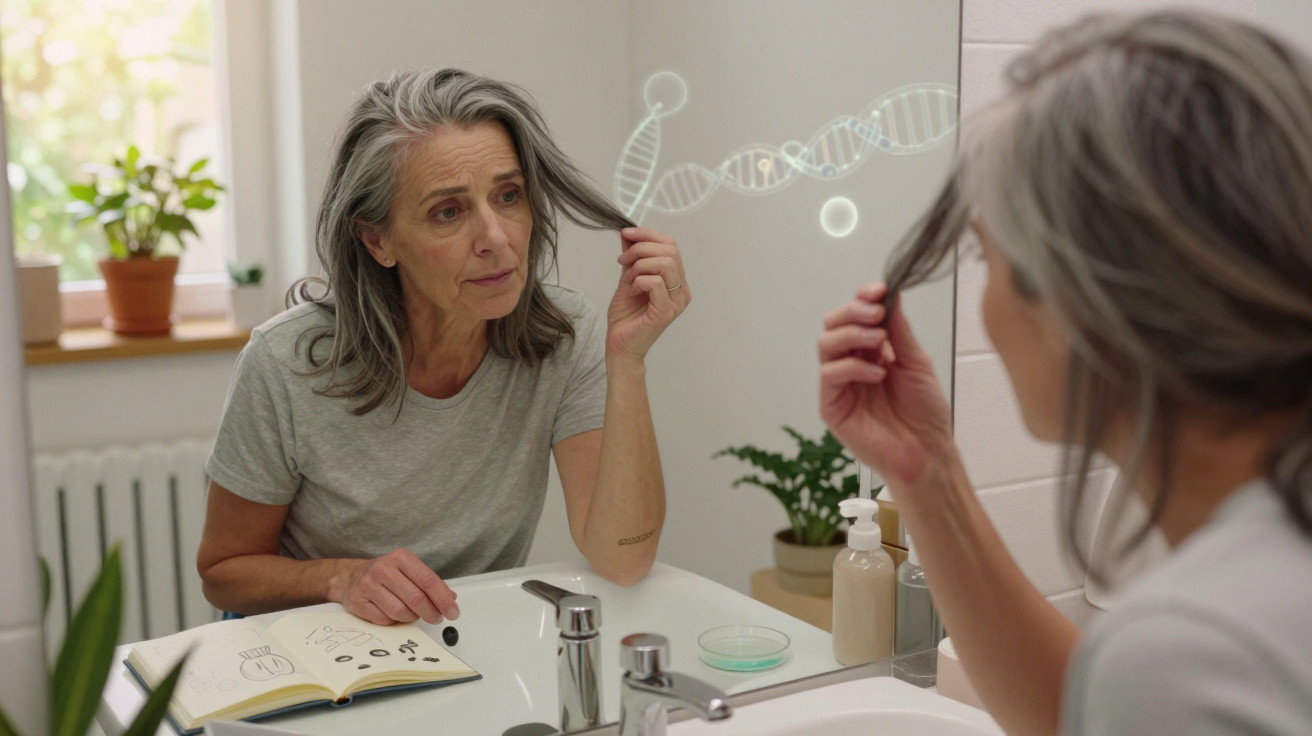
Those first silver hairs can feel like a personal betrayal.
But emerging research indicates they may be quietly benefiting your body.
Rather than merely being a cosmetic annoyance, grey hair could reflect a highly strategic cellular response: giving up pigment to reduce the likelihood of skin cancer. Scientists in Japan have detailed this trade-off with striking precision, offering a new perspective on ageing, tumours and what the mirror may be revealing.
When hair turns grey, your stem cells may be pulling the brake
The research, published in Nature Cell Biology in late 2025, was conducted at the Institute of Medical Science at the University of Tokyo. It examined a specialised population of cells found deep within every hair follicle: melanocyte stem cells.
These stem cells serve as a reserve supply of pigment. As new hair grows, they produce melanocytes, which deliver melanin into the hair shaft and determine whether hair is black, brown, blond or red.
In usual circumstances, these stem cells may remain inactive, divide to replenish themselves, or develop into pigment-producing cells. However, stress can radically alter the choices available to them.
Grey hair may be a visible trace of a hidden decision: better lose the pigment cell than risk a future melanoma.
In mouse experiments, the researchers subjected pigment stem cells to DNA damage, including exposure to X-rays, which cause double-strand breaks in genetic material. When the damage was serious, many cells declined to continue dividing. Instead, they activated a process known as “seno-differentiation”.
This process makes the stem cell mature permanently before it leaves the stem-cell pool. Its outward result is straightforward: fewer pigment cells, reduced melanin and, ultimately, grey or white hair. At cell level, however, it appears to be an act of self-sacrifice.
The p53–p21 axis: the safety circuit behind greying
This reaction centres on the well-known p53 pathway. Commonly described as the “guardian of the genome”, p53 detects DNA damage and can initiate repair, halt the cell cycle or cause cell death.
In this case, damaged pigment stem cells switched on a p53–p21 signalling cascade. This instructed them to avoid dangerous divisions and undergo terminal differentiation instead. In effect, they took themselves out of circulation.
By trading long-term renewal for a final, harmless differentiation, pigment stem cells seem to prioritise tissue safety over vanity.
The cost is visible ageing. The benefit is a reduced chance that an unstable cell could eventually become melanoma, the most lethal form of skin cancer.
When the system is hijacked: carcinogens that silence the grey alarm
This otherwise orderly defence does not always succeed. The same research found that some carcinogens can bypass this protection, allowing damaged cells to survive and keep dividing.
When mice encountered recognised skin carcinogens, including the chemical DMBA and UVB radiation, the researchers observed a concerning pattern. Despite DNA damage, pigment stem cells sometimes did not enter seno-differentiation. They retained their stem-cell state and their ability to self-renew.
This failure to self-sacrifice was not arbitrary. It was associated with signals from the cells’ local environment, or “niche”. One molecule was particularly notable: KIT ligand, often shortened to KITL.
KIT signalling: from safety mode to tumour-friendly mode
KITL is a growth factor produced by cells within and around the hair follicle, including cells in the outer skin. It activates the KIT receptor on pigment cells, increasing their activity and survival.
With substantial carcinogen exposure, the KIT/KITL pathway became active. Crucially, this increase weakened the p53–p21 safety signal.
When KIT signalling dominates, damaged stem cells may ignore the order to retire and instead keep dividing, setting the stage for melanoma.
Mouse studies supported this finding:
- Mice genetically altered to make additional KITL retained more damaged pigment stem cells following carcinogen exposure and developed more pre-melanoma lesions.
- Mice without KITL in their hair-follicle niche had greater p53 activation, more greying and a lower tendency to develop melanocytic tumours.
This difference reveals a stark biological crossroads. Depending on the chemical signals coming from its surroundings, the same type of stem cell may become either the marker of a grey hair or the origin of a cancer.
Ageing weakens the niche that guides stem-cell choices
The researchers also followed the changes that occur as skin gets older. Ageing is not simply the gradual deterioration of individual cells; it also transforms the environment around them.
In older mice, keratinocyte stem cells, which occupy the follicle niche alongside pigment stem cells, had lower p53 activity. They also released fewer important signalling molecules, including KITL and factors that help detect DNA damage.
This altered setting changed how pigment stem cells behaved. As they aged, they were less likely to enter seno-differentiation after sustaining damage. Rather than leaving through greying, more damaged cells remained within the stem-cell pool.
In younger skin, grey hairs may signal effective elimination of risky cells. In older skin, that signal can grow faint while silent mutations accumulate.
The team additionally identified increased activity in genes associated with arachidonic acid metabolism, a pathway connected to inflammation. Chronic low-level inflammation is already recognised as a contributor to cancer risk, and this metabolic change may form part of that relationship.
Grey hair and cancer: two outcomes of one decision system
Taken together, the findings recast the connection between ageing and cancer. They are not opposing outcomes, with one representing decline and the other unrestrained growth. Both may arise from the same decision-making mechanisms in stem cells.
When under stress, a pigment stem cell must balance competing paths:
| Cell choice | What happens | Visible effect | Long-term risk |
|---|---|---|---|
| Seno-differentiation | Differentiates and exits stem-cell pool | Grey/white hair | Lower melanoma risk |
| Continued self-renewal | Damaged stem cells keep dividing | Hair stays pigmented | Higher chance of tumour initiation |
Signals related to DNA damage, carcinogens and the niche shift this balance in either direction. The scientists call these “antagonistic fates”: sacrifice for safety versus persistence with risk.
What this means for people staring down their first grey hairs
The work was carried out in mice, and human biology is never an exact equivalent. Nevertheless, many of the key components involved, including p53, KIT and pigment stem cells, are strongly conserved among mammals. This makes the results more than a scientific curiosity.
For humans, the findings point to several possible practical implications.
Grey hair is not a cancer test, but it might be a sign of active defences
Early greying does not necessarily mean someone has greater protection from melanoma. Genetics, hormones, diet and stress all influence hair colour. Equally, retaining dark hair into later life does not mean that skin cancer is inevitable.
Still, the idea that greying can reflect the removal of risky cells provides a different way of viewing it. A mirror may not only show ageing; it may also show that stem cells can still pull the brake when necessary.
Future therapies could boost the “grey pathway” without changing hair
Cancer researchers are already seeking methods to remove damaged or senescent cells selectively. The seno-differentiation observed in hair follicles is, in effect, a natural and highly selective version of this approach.
In theory, medicines that alter p53–p21 or the KIT/KITL axis in the skin could encourage pigment stem cells to take the safer route after UV damage, reducing melanoma risk. Comparable approaches might also work in other stem-cell populations, such as those in the gut or blood.
Clinicians would have to strike a careful balance. Excessively activating these routes could produce signs of premature ageing, including faster greying, or exhaust the stem-cell reserves required for normal tissue repair.
Key concepts behind the science, in plain language
What are melanocyte stem cells?
They are the “mother cells” responsible for producing melanocytes, the pigment-making cells in hair follicles. Without them, newly grown hair has no colour.
Because they can self-renew and survive for years, mutations that evade their safeguards may have lasting consequences, including laying the groundwork for a later tumour. This is why their response to stress is important.
What is seno-differentiation and how is it different from senescence?
Cellular senescence is a condition in which cells stop dividing but stay alive, often releasing inflammatory substances. In this setting, seno-differentiation describes cells responding to damage by maturing fully and then leaving the stem-cell pool.
The Tokyo team’s findings indicate that seno-differentiation may act as a “clean exit”: a cell completes one final useful role before stepping aside, avoiding both tumour development and some chronic inflammation linked with senescent cells.
Everyday scenarios: sun, age and that single white strand
Consider two middle-aged people who spend years in the sun. In one, the skin environment strongly activates p53 in pigment stem cells after UV exposure. In the other, p53 signalling is weaker and KIT activity is stronger, potentially because of inherited characteristics.
The first individual may gradually see greying at the temples, particularly in areas exposed to sunlight. The second may keep dark hair for longer, but face a greater lifetime possibility that a damaged pigment cell will evade control and develop into melanoma.
Dermatologists might eventually apply this type of stem-cell decision framework when evaluating risk, alongside established factors such as skin type, mole number and previous sunburn. Laboratory testing of very small skin samples could indicate whether a person’s pigment stem cells favour sacrifice or persistence when stressed.
For the moment, the practical guidance is largely unchanged: shield your skin from excessive UV, inspect moles regularly and consult a professional about anything that changes in shape, colour or size. The unusual implication is that a new grey streak after a difficult period or intensive treatment may be more than unfortunate timing. It could represent biology favouring caution over cosmetics.
















Comments
No comments yet. Be the first to comment!
Leave a Comment