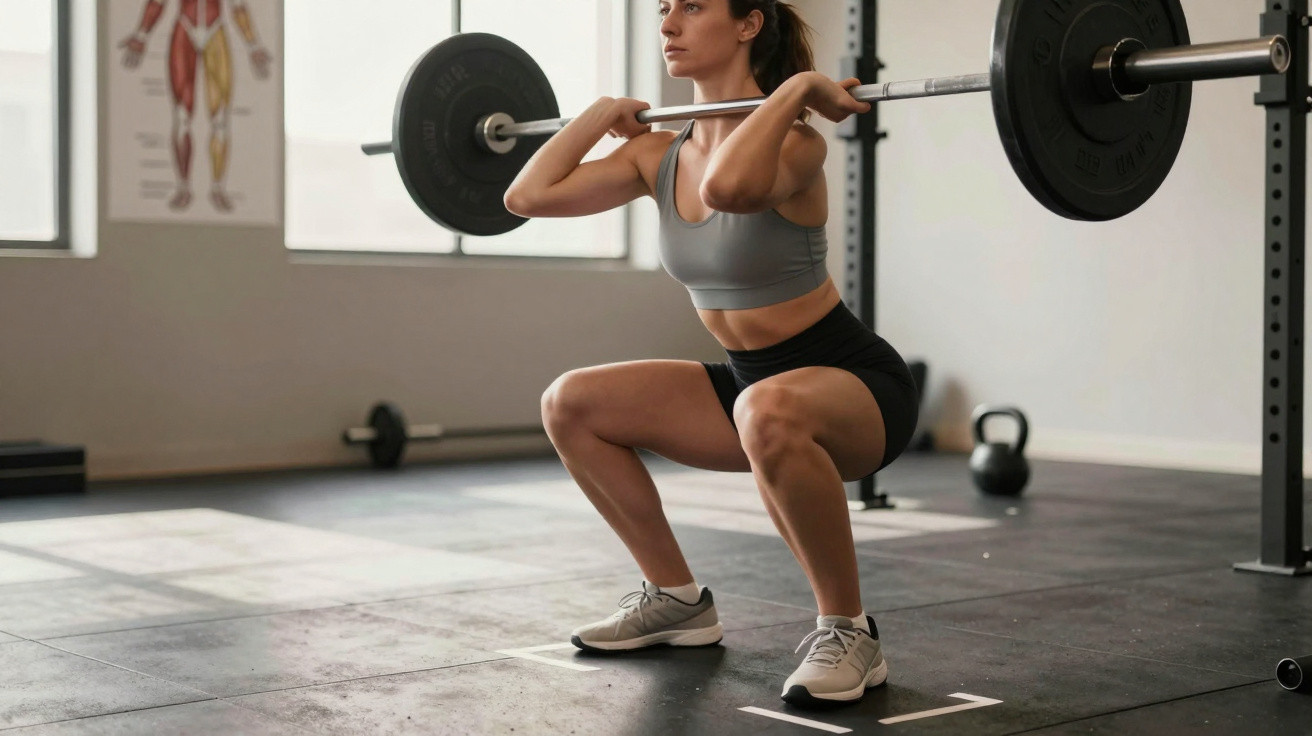
Sweat drips, someone lets out a quiet groan, and a stopwatch clicks somewhere nearby. At the rack, a woman is battling through her squats – strong back, clean alignment, and her coach gives an approving nod. Yet later, as she leans against the changing-room wall, she says softly, part frustrated and part curious: “I only ever feel it in my glutes, never here on the inner thigh.”
We all know that moment when the body does not respond in the way we had planned in our minds. You do everything “right”, but one muscle somehow remains silent. The coach takes a step back, looks at her feet and turns them out by a few centimetres. Same set, same barbell – but suddenly something changes in the athlete’s expression. A brief look of surprise.
Such a small adjustment – yet the whole squat feels different.
Why a few degrees of foot angle can completely change your squats
Ask five people at the gym how your feet should be positioned for squats and you will probably hear seven different answers. Feet parallel, slightly turned out, wide or narrow – everyone swears by their own version. In everyday training, though, the same pattern is common: people copy the stance of their favourite influencer without realising that their hip structure may be completely different.
In practice, a tiny turn of the feet can be enough for muscles you thought were dormant to suddenly make themselves known. The adductors – the inner-thigh muscles – are particularly good at hiding. They contribute, stabilise and keep the knee tracking properly, but they are rarely the star of the show.
Turn your feet out by only a few degrees and deliberately guide your knees towards your toes, and the distribution of effort changes. The adductors move from being background players to taking on an important supporting role. It is not dramatic or showy, but it is very noticeable.
It is a scene that appears more and more often: an ambitious recreational athlete with solid technique, decent quadriceps and rounded glutes, yet visually there seems to be a kind of “gap” between the legs. It is not a problem, just that feeling of: “There is more to come.” In coaching, there is no magic trick and no flashy new exercise. The stance is simply adjusted.
The feet move a little farther apart, perhaps from hip-width to shoulder-width, while the toes change from almost parallel to a 15–30-degree outward angle. At first it looks unfamiliar and feels slightly unsteady as the balance shifts. By the third or fourth set comes the response every coach loves: “Wow, now it’s burning on the inside! What was I doing before?”
Squat studies repeatedly show that stance width and foot angle have a substantial effect on which muscles do most of the work. A wider stance with feet pointed slightly outwards increases adductor activation because those muscles work from a lengthened position that is ready to produce tension. Put simply: the more the knees travel forwards and slightly outwards in line with the outward-pointing toes, the more the inner thigh is recruited.
The straightforward truth is that there is no single “perfect” squat angle; there is only the angle that suits your body. What creates excessive adductor strain for one person may be exactly the sweet spot that lets someone else finally feel inner-thigh tension. The skill lies in looking for that point with curiosity rather than dogma.
The small angle adjustment: how to bring your adductors into the squat
Stand barefoot or in flat shoes in front of a mirror. Take a moderate stance, around shoulder-width apart or perhaps a touch wider. Begin with your toes neutral or slightly turned out; do not immediately drop into an extreme sumo position. Then rotate both feet so that they point roughly 20–30 degrees outwards. This is not a right angle, but a gentle fan-like position.
As you lower into the squat, intentionally guide your knees towards your toes. Do not let them collapse inwards; instead, think of two sliding doors moving outwards and forwards. Breathe in on the way down, feel the inner thigh lengthen, then drive powerfully upwards through the whole sole of the foot. When you find the moment where there is a slight pull inside the groin and along the thigh, you are getting close.
Let’s be honest: nobody holds a perfect technique session focused solely on foot angle every day. Many people simply load up the bar and hope everything will grow somehow. But if you specifically want to bring the adductors into play, this fine-tuning is worth doing. Reduce the load for one training session, move slowly and pay close attention to the feeling – it may look unspectacular, but it builds the foundation for long-term progress.
The first common mistake is turning the feet out while still allowing the knees to drift inwards. That reduces the work done by the adductors and places more stress on the knee. The second is taking such an extremely wide stance that you spend more effort trying not to fall over than squatting with good form. Width is not an ego tool; it is a lever to use in measured amounts.
Many people also underestimate how sensitive the body is to small changes in angle. An extra five degrees, or five degrees less, can already determine whether you feel tension on the inside or the outside of the thigh. A good approach is to use light weight and spend three sets simply experimenting. Move a few millimetres narrower, add a few degrees of external rotation, pause at the lowest point – and observe where the muscle “wakes up”.
At first, this can feel strange, almost like moving backwards. You use less weight, need more focus and your ego objects. But this is exactly the stage in which your body learns the details that later make the difference between “looks all right” and “feels powerful and controlled”.
“I did not need more weight, just a better feel for my stance. The moment I understood that five centimetres of foot position could change my entire squat, technique suddenly became more exciting than any new exercise.”
If you want to turn this idea into a small ritual, a few clear points can help:
- Settle into your stance briefly before every squat – without the barbell, simply position your feet and take two or three breaths.
- Do not guess your foot angle; choose it deliberately – moderate turnout is better than an extreme “frog stance”.
- During the first warm-up sets, consciously feel for the inner thigh rather than immediately thinking about your working weight.
- Pause for a moment after every set: where did you feel it? On the inside, outside or only in the glutes?
- Include regular technique sessions with light loads – at least once a week for 10–15 minutes.
What these small angles reveal about your body
Once you start experimenting with foot angle and stance width, you quickly learn more about your hips than any app could tell you. Some people immediately feel a comfortable stretch in the adductors with a slight outward angle, while others meet a restrictive limit at exactly the same angle. That feedback is not a weakness; it is a compass. It shows you which angles your body likes to work in and where tightness, old movement patterns or simple lack of practice may be present.
Over time, this creates a kind of personal “squat map”. You learn which angle keeps your knees steady, where your back feels secure and at what point the inner thighs begin to contribute seriously. This map is valuable because it makes you less dependent on rigid textbook images. You no longer need to believe anyone trying to sell you one single “true” foot position.
Behind this entire discussion about foot angle is a bigger question: how do we treat our bodies when there is no mirror and no coach present? Do we rely on automatic habits, or do we occasionally take the time to feel things out one millimetre more precisely? Squats then become more than a pure strength exercise; they become a quiet conversation between you, the floor and your own awareness.
Then comes that unexpectedly satisfying moment at the gym: you squat, press back up, return the barbell to the rack – and, on the way to your water bottle, notice that your inner thighs are quietly glowing. Not excessively and not painfully. Just that satisfying sense that a muscle you had drowned out for a long time has finally been allowed to join in.
| Key point | Detail | Benefit for the reader |
|---|---|---|
| Feet turned slightly outwards | Around 15–30 degrees of external rotation encourages active adductor involvement | Helps you specifically feel and train the inner thigh in the squat |
| Knee tracking towards the toes | During the squat, the knees move towards the toes rather than inwards | Protects the knees, improves stability and increases inner-thigh muscle tension |
| Technique experimentation instead of ego loading | Test different stances and angles with a light load while paying conscious attention | Enables an individual squat technique suited to your body rather than rigid templates |










Comments
No comments yet. Be the first to comment!
Leave a Comment